
Corkscrew Hill and the narrow roads
The road from Lisdoonvarna drops to Ballyvaughan in a series of hairpin bends built in famine years. A guide to the view and to sharing Burren roads gently.
Ground: Road and pathFrom Ballyvaughan: Ten minutes south by carWay in: N67 south from Ballyvaughan towards LisdoonvarnaBring: Patience, lights and high-visibility gear for cycling
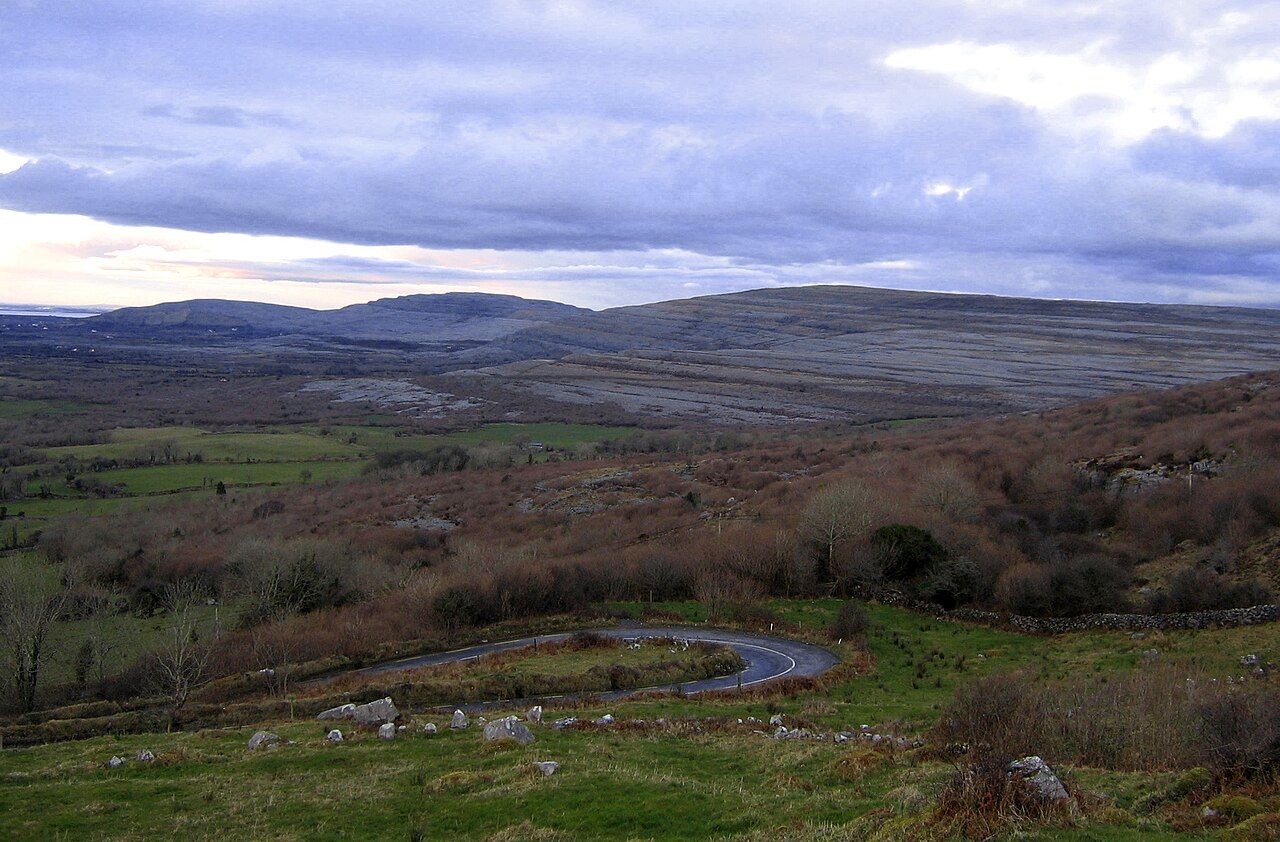
Ballyvaughan sits low on the shore of Galway Bay, and every road south out of it has to climb. The main one, the N67 towards Lisdoonvarna, does it in style. After a few kilometres of valley floor it turns up the hillside in a series of tight bends, folding back on itself as it gains height. This is Corkscrew Hill, and it is one of the best known stretches of road in Clare.
A road built in hard years
The road over Corkscrew Hill was built in the late 1840s as famine relief work. During the Great Famine, public works schemes gave hungry people paid labour on roads, walls and other projects, often in harsh conditions and for very low pay. Many of the roads built this way led nowhere in particular. This one, at least, joined two places that needed linking, and it is still in daily use.
It is worth remembering that history as you drive. The neat curves and stone walls were made by people who were often weak from hunger, working on a hillside exposed to Atlantic weather. The road is a monument of a kind, even if it is not marked as one.
The view from the bends
The reason most people stop is the view. As you climb, the land opens out behind you: the valley floor with its fields and scattered houses, the village, the bay beyond, and on clear days the far shore around Galway. To the sides rise the grey terraced hills of the northern Burren, their stepped slopes clearer from here than from almost anywhere.
There are few safe places to pull in on the bends. If you want to stop, look for proper lay-bys or wider verges at the top, and never stop on a bend or in a passing space that others need. Better still, park higher up and walk back a short way to a safe viewpoint.
Light changes the view completely. Early morning can be still and clear over the bay; late afternoon brings long shadows that pick out the terraces on the hills; in rain or fog the valley may vanish altogether. A trip down in the evening, with the sun low over the sea, is one of the quiet pleasures of staying in the area.
The roads beyond
Corkscrew Hill is only one of several ways across the Burren. The R480 climbs south from Ballyvaughan past Poulnabrone and down to Leamaneh. The coast road runs west round Black Head to Fanore and Doolin. Smaller lanes cross the high ground between them, many barely wider than a car, with grass growing down the middle.
Nearby Lisdoonvarna, the town of the waters
Each road has its own character. The R480 is the main route for visitors to the high Burren and can be busy in summer. The coast road is slower and more exposed, with sea on one side and rock on the other. The lanes are quiet but demand care, with blind bends, steep dips, livestock and farm traffic.
Driving with courtesy
The roads here were not built for coaches or wide cars, and some visitors find them stressful. A few habits make a big difference, for you and for the people who live and work here.
- Drive slowly enough to stop in the distance you can see. On narrow lanes that may be very slow indeed.
- When you meet another vehicle, use the nearest wide spot or gateway. Whoever is closer to a passing place usually reverses.
- Never park across a gate or in a passing place. Farmers need access, often with machinery or animals.
- Expect cattle, sheep, tractors and walkers around any bend. In winter, cattle may be moved along roads to and from the uplands.
- Do not stop suddenly to take photographs. Pull in safely first.
A raised hand to drivers who pull in for you is common practice and much appreciated.
Cycling the hill
Corkscrew Hill is popular with cyclists. The climb from Ballyvaughan is long and steady rather than brutal, with the hardest work on the bends. Coming down, the bends are tight and the surface can be wet, gritty or greasy, so control your speed carefully.
- Wear bright clothing and use lights, even by day. Visibility can drop fast in rain or fog.
- Ride in single file on narrow stretches, and let traffic pass where it is safe.
- Carry a waterproof layer; it can be much colder and windier at the top than in the village.
- Watch for loose stones and animal mess on the road, especially near gates.
Drivers, for their part, should give cyclists plenty of room and wait for a safe place to pass. Most of the Burren is better seen slowly, and riders are only doing what everyone should.
Walking near the road
The main road itself is not a good place to walk, with no footpath and limited verges. For walking, use the waymarked routes nearby, including sections of the Burren Way, and the quiet lanes and green roads that cross the hills. Many give views as good as the road's, with no traffic at all.
At the foot of the hill, near the start of the climb, stands a round tower house described in our guide to the tower houses of the Burren. Combine it with a trip up the bends and back, and you have a short outing that covers road, history and view in a couple of hours.