
Kilfenora and the crosses under glass
A village at the southern edge of the Burren keeps a small ruined cathedral, a group of twelfth-century high crosses and one of the oddest dioceses in the Church.
Ground: Road and pathFrom Ballyvaughan: Around half an hour by carWay in: Via Lisdoonvarna or the R480 and R476Bring: Rain jacket, binoculars for carving detail
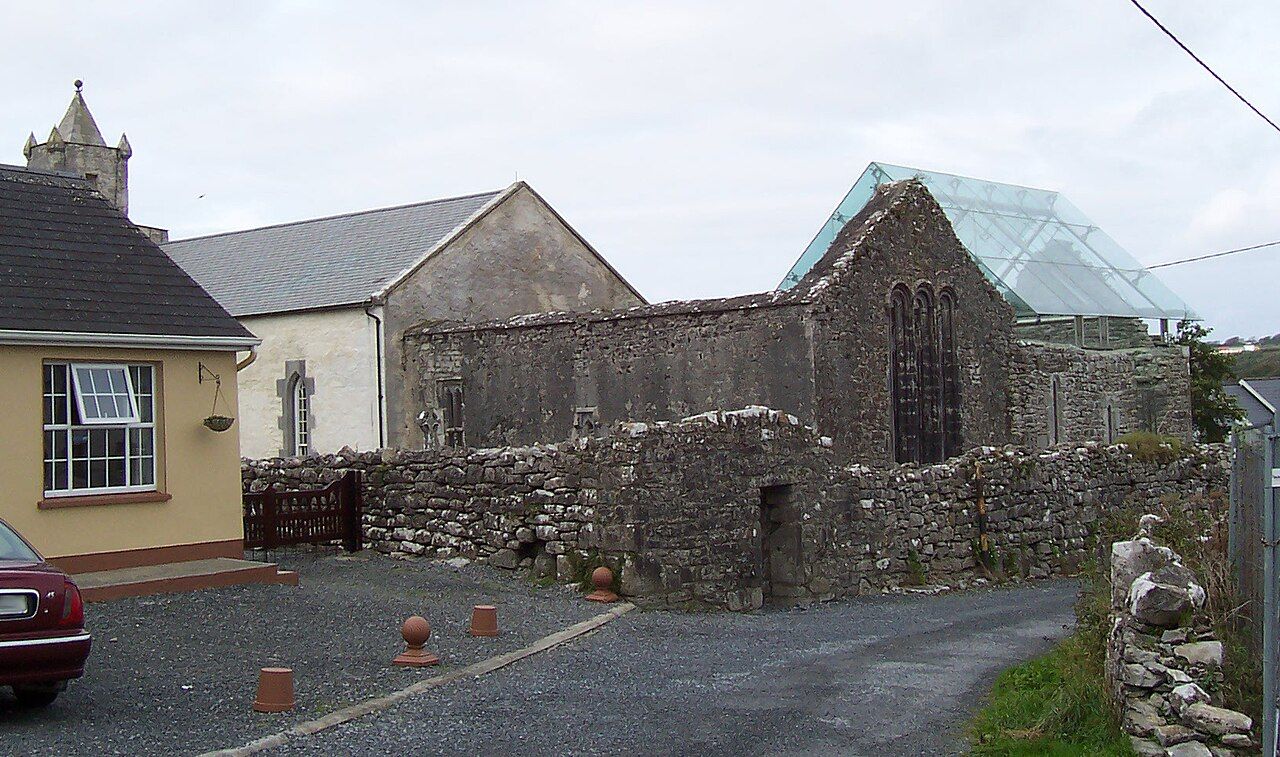
Kilfenora is a small village where the limestone uplands drop away towards the green farmland of mid Clare. A main street, a church, a few houses: you could drive through without stopping. That would be a mistake, because beside the road stands the old cathedral of Kilfenora, and inside it, sheltered from the weather, is one of the best groups of carved high crosses in the country.
A cathedral on a small scale
Cathedral is a big word for a modest building. Kilfenora's is a long, low stone church, part of it roofless, standing in a graveyard at the edge of the village. The site is linked with Saint Fachtna, and a church was here well before the present building, which dates mainly from the twelfth and thirteenth centuries.
The chancel, at the east end, is the part to look at first. Its three tall, narrow windows are framed by carved stonework, and inside there are carved heads and the worn figures on tomb niches. Over the years parts of the building have been adapted and repaired, and you can see the joins between different periods in the walls.
The crosses under the glass roof
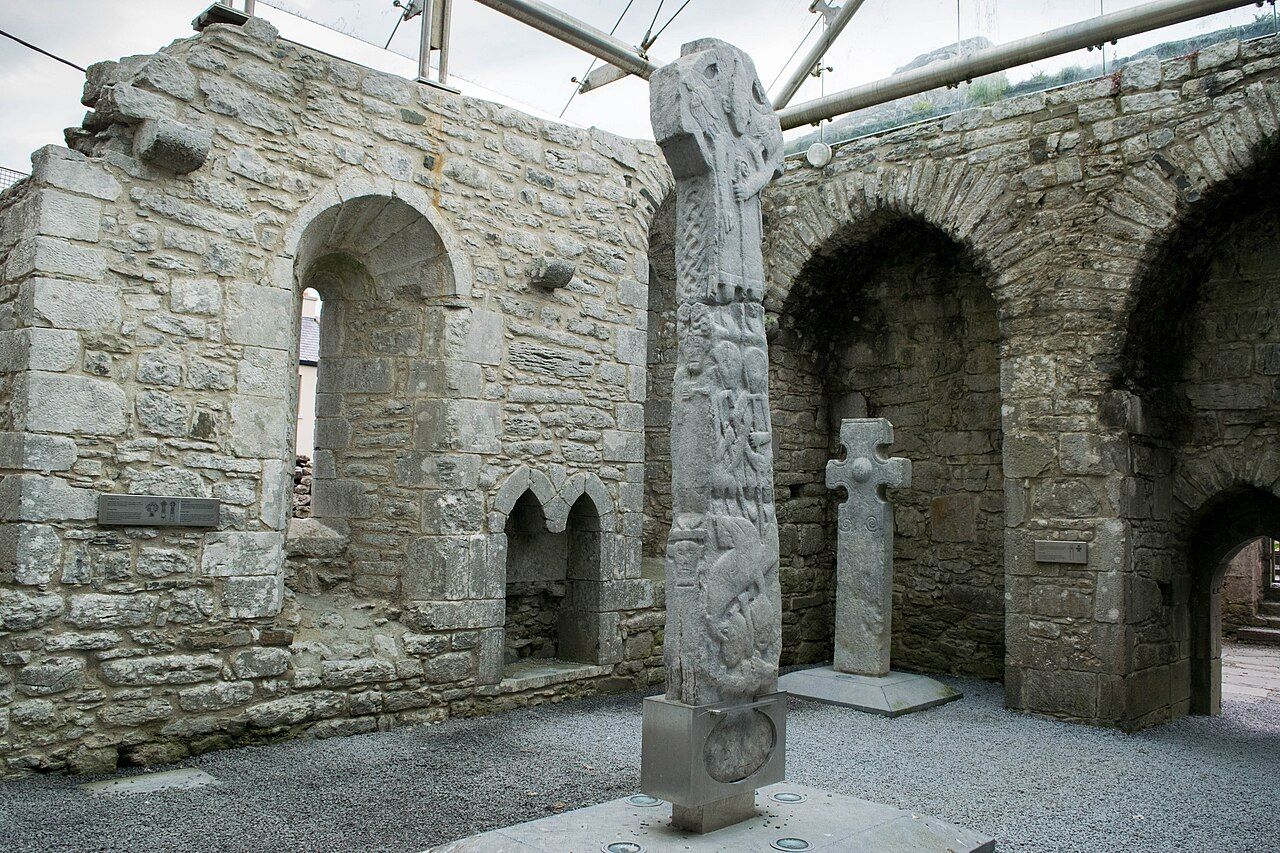
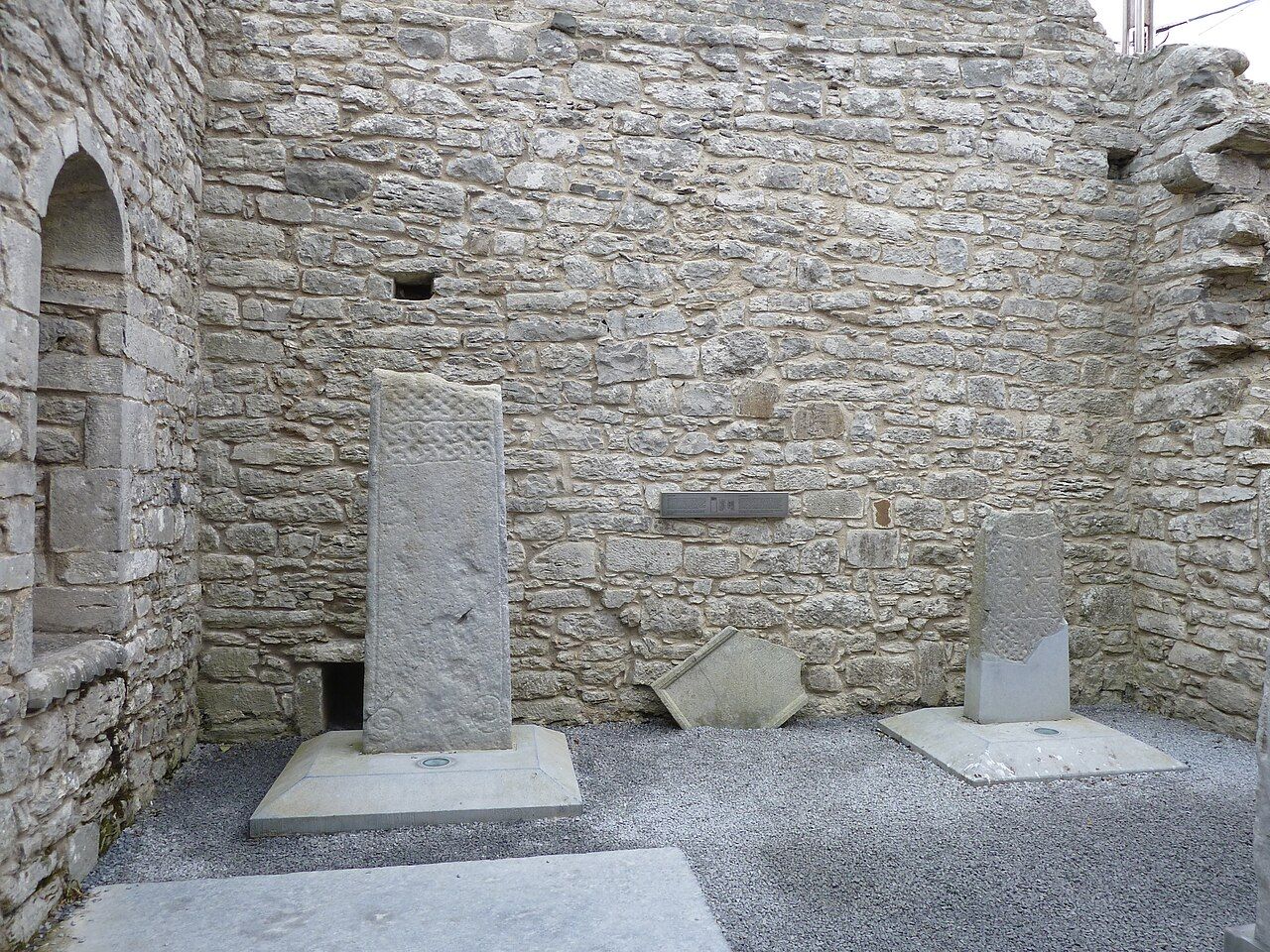
For centuries, several stone crosses stood outdoors around the cathedral, exposed to rain, frost and lichen. To protect them, the most important were moved under cover, and a glass roof was built over part of the ruined church so that they could be seen in natural light while sheltered from the worst of the weather. The roof is a modern structure in an old shell, and it works well: the crosses are bright and easy to see, and the carving has a far better chance of surviving.
The best known is the Doorty Cross. Its head and shaft are carved with figures, among them one usually read as a bishop or abbot with a crozier, along with other figures, animals and interlace. Scholars have argued for a long time about exactly what the scenes mean. Some see a statement about the authority of the local church, others a set of biblical references. You do not need to settle the question to enjoy the quality of the work.
Other crosses and cross fragments stand nearby, some with plain shafts and fine interlaced patterns, others damaged or incomplete. Look closely at the edges and the backs as well as the main faces; some of the most delicate carving is on the narrow sides.
Not every cross was moved indoors. A tall cross still stands in a field to the west of the church, as crosses here once did, and seeing it in the open helps you imagine the site when all of them stood in the weather.
A diocese like no other
Kilfenora was the seat of a small medieval diocese, one of the smallest in Ireland. Over time it was joined with larger neighbours for practical purposes, and for well over a century it has been looked after by a neighbouring bishop on behalf of the Pope. That arrangement is behind the local saying that the Pope himself is the bishop of Kilfenora. The details are technical and have shifted over time, but the saying is a good conversation piece, and it hints at how much the church landscape of the west has changed.
Nearby Corcomroe, the abbey of the fertile rock
The diocese helps explain why such fine crosses ended up in such a small place. A cathedral, even a small one, meant a bishop, clergy and patrons, and the crosses may have been set up partly to mark the status of the church at a time when dioceses across Ireland were being reorganised.
How to visit
The cathedral is in the centre of the village, and the graveyard is easily reached on foot. Access to the sheltered area with the crosses is generally open.
- Bring binoculars or use your phone's zoom to look at carving high on the crosses; the details reward patience.
- Do not touch the carving. Skin oils and repeated rubbing damage soft stone surfaces.
- Be quiet and respectful in the graveyard, which is still used by local families.
- On grey days, the light under the glass roof is soft and even, which is good for seeing low relief.
Allow an hour if you want to take in the crosses, the chancel and the field cross properly, longer if you enjoy reading carved stone.
Kilfenora as a base for the south Burren
The village lies on the edge of the limestone, and the uplands are only a short drive or a long walk away. To the north and east, the roads lead past Leamaneh Castle and on to the national park around Mullaghmore. To the west, Lisdoonvarna and the coast are close.
Kilfenora also has a long tradition of music and dancing, and in the evenings, especially in summer, you may hear sessions in the village. Times and places change, so ask around rather than relying on what you read online.
Combining it with other sites
A good loop from Ballyvaughan runs south over Corkscrew Hill to Lisdoonvarna, east to Kilfenora for the crosses, then back north through the high Burren past Poulnabrone. That gives you, in one day, the hills, the spa town, the medieval church and the prehistoric tomb. If you prefer to walk, quiet lanes link the village with the uplands.
Whichever way you come, give the crosses time. They are not large, and they do not shout, but they are some of the finest things the region has to show.